Average Reviews:

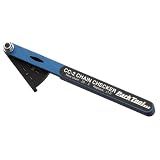
(More customer reviews)This tool measures chain-wear and it's very simple to use.The bottom of the tool has two metal pins, one pin is mounted to a lever and is offset in a way that changes the spacing between the pins when the lever is moved.This allows you to very precisely measure how much a bicycle chain has stretched.The stretch amount is visible through a small window.
The tool is machined out of solid aluminum and the color is anodized (not painted).There are no plastic or fragile parts.The tool will never wear out -- one is all you'll need for the rest of your bike-riding life.
Chains have a sequence of narrow & wide links.Each narrow & wide pair of links on a new chain will measure exactly 1.0" from center of pin to center of pin.If you were to use a ruler to measure 20 links (10 "pairs") it should measure exactly 10.0" on a brand-new chain.The chain will stretch with use as the hinge points wear.1/16th of an inch is normal -- at 1/8" it's time to replace the chain.But using the Park Tool is a easier and faster than using a ruler.
Set the lever to the "0" position and set the tool on your chain (keep mild tension on the chain to get an accurate reading -- measuring a chain hanging slack will not be accurate) so that the pins on the tool are between the links on your chain.Push the lever until it stops then read the stretch value through the window on the tool.A brand new chain will measure .0 -- any used chain will have some stretch.Values below .5 are considered normal/acceptable amounts of wear (the tool reads from 0 to 1.0 in .25 increments.), but above .5 means your chain will need replacing soon.I replace my chains when they read .75.
Why do you care?
Chains are relatively inexpensive and easy to replace, but if they're not replaced they can create problems.The chain will begin to slip and jump -- usually under heavy load such as trying to ride up a steep hill or on an aggressive climb on a trail (which is exactly when you _don't_ want that to happen). A stretched chain will also wear the sprockets -- it'll mildly affect the front chainrings, but it can more rapidly affect the rear freewheel or cassette and these are more expensive to replace.
If you ride aggressively on trails you should be checking your chain about every 100-200 miles of riding.If you ride more gently or only on mostly flat streets then you may only need to check every 300-500 miles.
I give this tool 5 stars (and I'm not one to just give out five stars because I bought one myself) because it's simple to use, it's easy to read, it's accurate, and it's constructed of durable materials -- not cheap plastic parts -- down to every detail (including anodizing the aluminum instead of painting it -- so there's not even any paint to wear off.)They did everything right when they made this tool.I couldn't ask for anything more.
Click Here to see more reviews about: Park Tool Chain Checker - CC-2
Product Description:
The Park Tool Chain Checker resolves unanswered questions about the life left in your chain. Broken chains suck, and worn chains don't shift well, so give your a check-up with the Park Tool Chain Checker.
Product Features
Includes: Chain checker
Recommended Use: Determining chain wear
Manufacturer Warranty: Lifetime
 Get 27% OFF
Want to read more honest consumer review about Park Tool Chain Checker - CC-2 now ?

0 comments:
Post a Comment